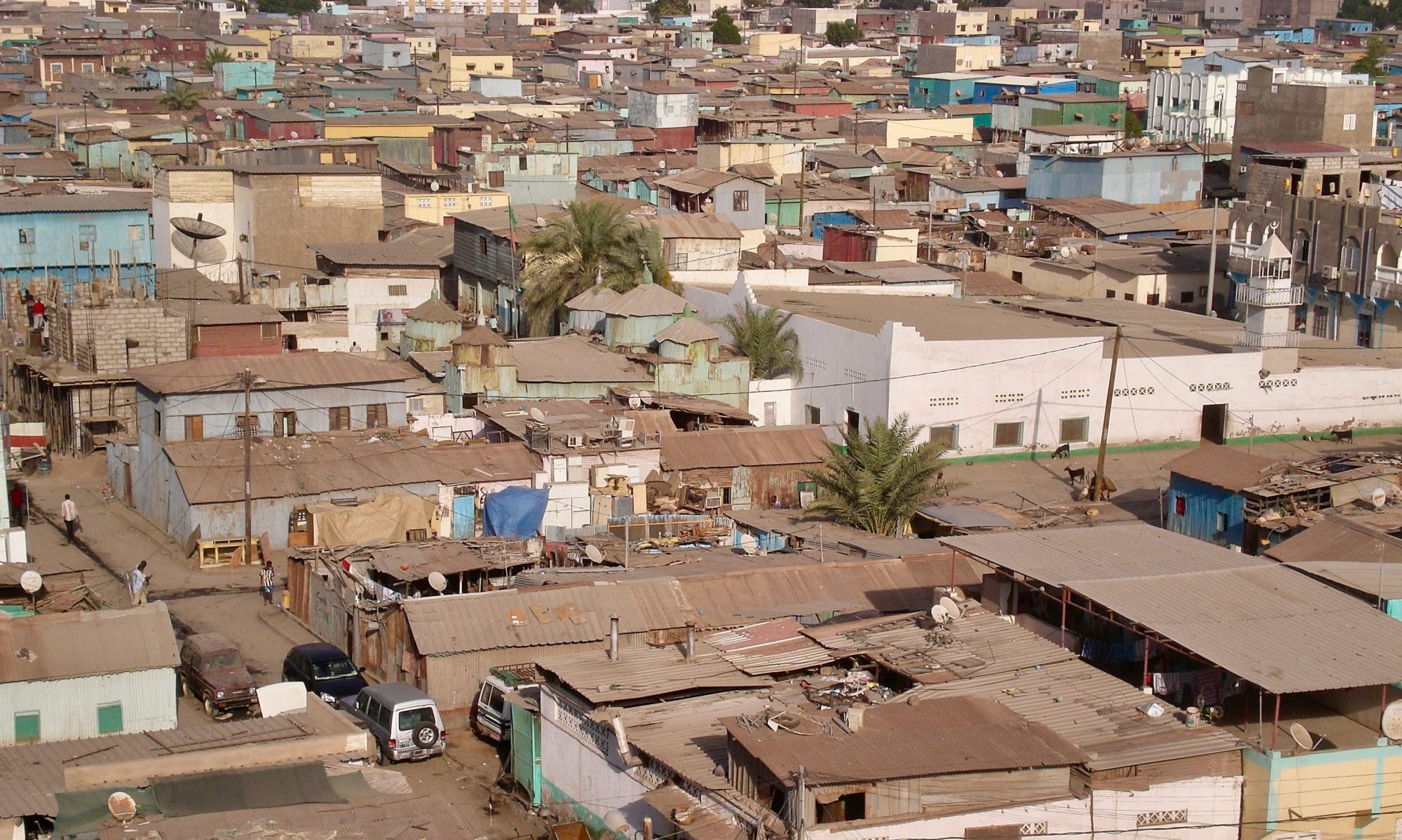

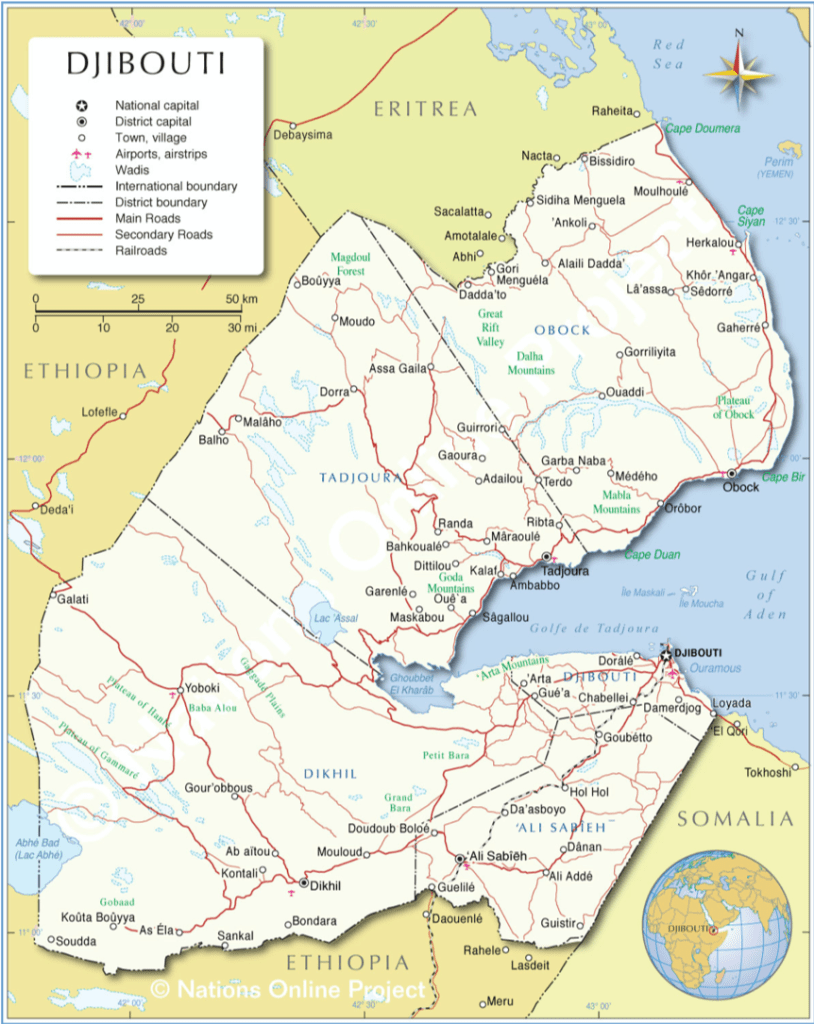
Djibouti is a small country, one of the smallest in Africa. It is arid and hot (possibly the hottest on earth) with few natural resources. However, it is situated in a key area in the Middle East on the Bab el-Mandeb Strait that connects the Mediterranean Sea to the Indian Ocean via the Suez Canal and the Red Sea, so hosts military bases for USA, France, Italy, Japan and now even China. The bases are a source of income and employment as is its role in providing seaports for landlocked Ethiopia. It has a population of about 1,000,000 and is politically stable, unlike many of its neighbours, but has 50-80% unemployment and a national addiction to qat (an amphetamine-like stimulant drug that is legal and has been socially acceptable for hundreds of years). It has a Human Development Index Ranking of 172/189 countries indicative of a severe degree of poverty and deprivation. It is an Islamic state but does not follow Sharia Law. Its ethnic, clan and family structure has greater influence than Islam. There is a small Christian community and the Catholic, Ethiopian Orthodox and French Protestant Churches are recognised by the government.
Average annual rainfall is 127 mm (5 inches), and humidity is high year-round. Fair weather dominates the area; however, certain seasons, particularly summer, have a dust haze. During the May to September summer season, temperatures range from 32ºC to 49ºC (90ºF to 120ºF). The winter season has sparse rainfall, cool breezes, and temperatures near 20ºC (70ºF). The khamsin is a strong, hot, sand-laden wind that blows during the summer season. It usually begins at 1pm and ends between 8pm and midnight. Occasionally, the khamsin begins in the morning and lasts for 3 to 4 days, with winds exceeding 50 knots. The blown sand can damage equipment. Djibouti has another strong wind called the saba. It differs from the khamsin because it is always cool. Occasionally the saba is accompanied by light rain and, as a result, it disturbs less dust than other winds. It occurs only in the morning hours during the summer, beginning and ending abruptly.
Djibouti is susceptible to droughts and occasional cyclonic disturbances that bring heavy rains and flash floods. Since 1986, Djibouti has had two droughts (February 1988 and July 1996) and three floods (April 1989, November 1994 and November 2019) that required humanitarian assistance.
50% of the urban population and 79% of the rural population do not have safe drinking water. 51% of Djibouti’s water supply is used for farming; however, the salinity of the water supply is increasing. The persistent discharge of untreated sewage into surface waters and coastal areas is a pollution problem. Although Djibouti City has a wastewater treatment plant, it is reportedly inoperable; its sewage is dumped into streams, the Gulf of Tadjoura, and into the desert. Discharges from offshore tanker traffic contribute to the petrochemical contamination of Djibouti’s coastline.
Djibouti was created by the French in 1884 but, at a referendum in 1977, the electorate supported disengagement from France. The Republic of Djibouti was formed. The national boundaries cross territory historically occupied by the Somali and Afar people. Conflict between them has gone on for centuries and this recurred in a civil war (1991-94) and is expressed in social structures so that ethnicity is more significant than nationhood.
Nevertheless, it is a peaceful country and there is a culture that permits personal development and choice in contrast to the strong communal, and honour based culture that predominates in most Arabic societies. Most people are Somali (61%), but in the north Afar (28%) are predominant. There are a significant number of Yemeni who are economic migrants or refugees from Yemen and a number of Ethiopian migrant workers. French and Arabic are the official languages but many are eager to learn English as it is so important for employment. Its capital is Djibouti City where 75% of the population live.

